
Sediments Out of Balance
Understanding Sediment Dynamics – The Foundation for Healthy Water Bodies
Sediment – A Key Process in Flowing Waters
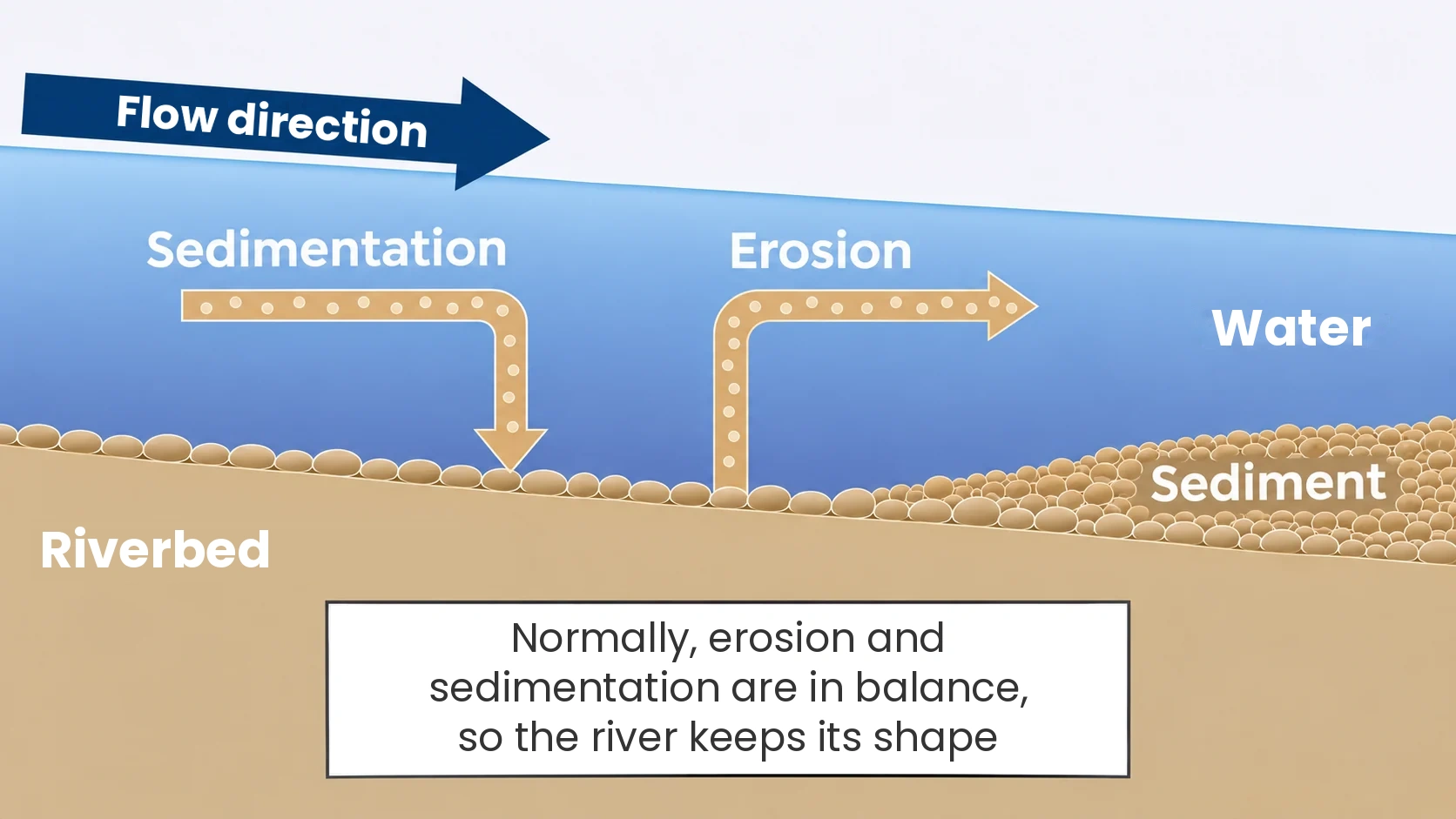
Sediment is much more than material deposited on a riverbed: It is a fundamental component of natural river processes. Every flowing watercourse transports sediment, from fine particles to coarse material originating in the watershed through erosion and carried downstream by the current.
Depending on flow velocity, channel gradient, and seasonal conditions, sediment is deposited, transported, and re-entrained. Over years and decades, a stable sediment balance develops in the middle and lower reaches of a river. As a result, the watercourse largely maintains its natural form and remains ecologically functional.
Sediment protects the riverbed and banks from erosion, serves as a habitat for benthic organisms (benthos), and forms the natural substrate that is essential for structural diversity in the water. Disturbances to this system therefore have far-reaching consequences.
Reservoirs as Sediment Traps – With Far-Reaching Consequences
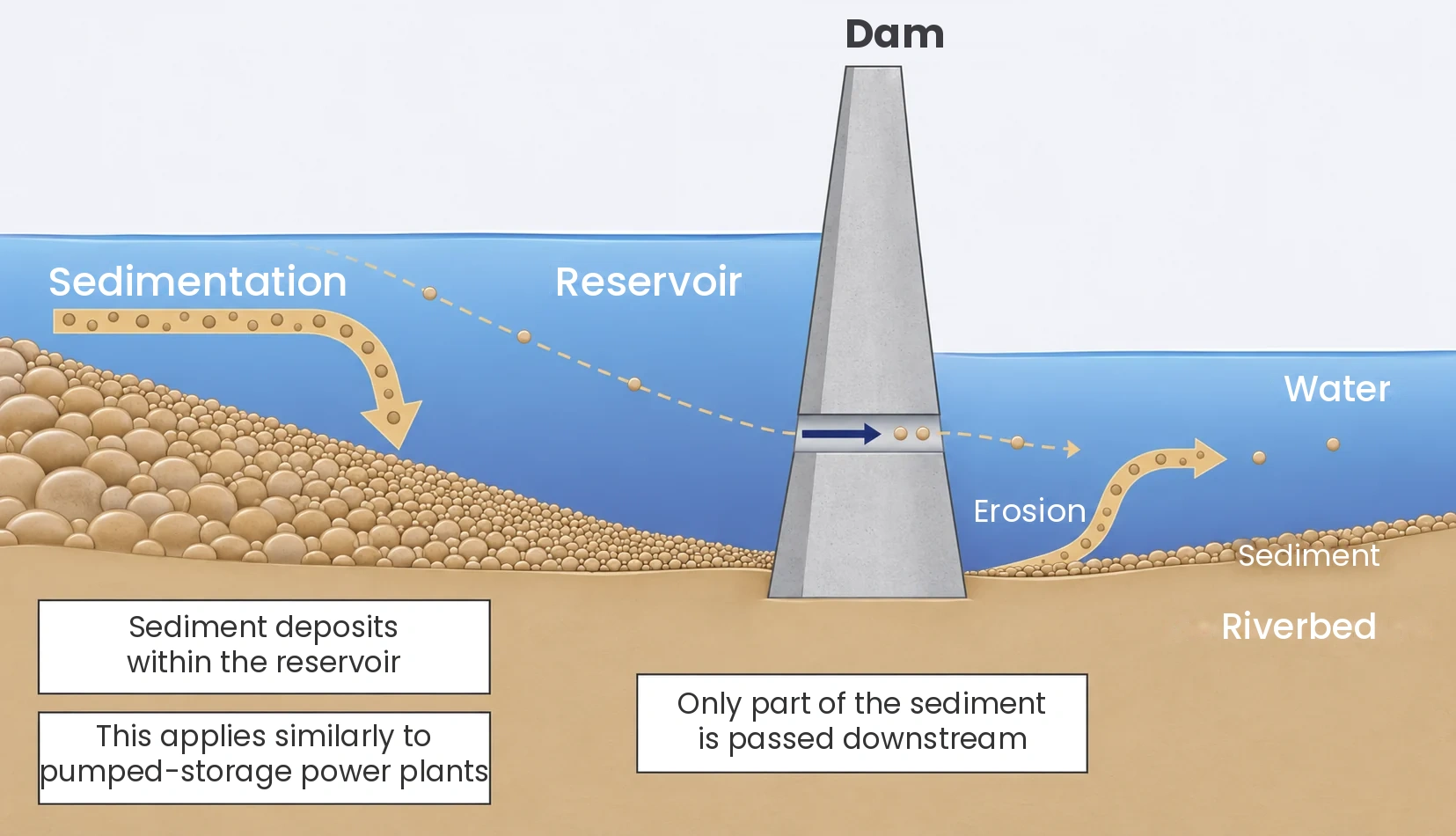
Human interventions, particularly through the construction of dams and other transverse structures, significantly disrupt the natural balance of sediment dynamics. Once a river is impounded, its flow conditions change. Sediments accumulate in the reservoir rather than being transported further downstream. This leads to increased sediment deposition in the upstream sections, which can eventually result in the reservoir silting up. A hydrographic survey that determines the sediment volume shows how far this has progressed. Consequently, the available storage volume is reduced, the operational storage capacity is restricted, and, last but not least, the accumulated sediment deposits may even compromise the structural stability of the dam.
At the same time, sediment supply downstream is insufficient. As a result, the river begins to erode its own bed. This leads to riverbed and bank erosion, alterations in groundwater levels, habitat loss, and damage to infrastructure. Many large rivers around the world are currently suffering from severe sediment deficits, a problem that has so far proven difficult to fully compensate for, even through large-scale artificial sediment replenishment.
Conventional solutions: Labor-intensive, costly, and often unsustainable.
To mitigate the impacts of disrupted sediment dynamics, conventional measures have traditionally been employed, including reservoir flushing, dredging operations, flow diversions, and extensive river modifications. However, these approaches often come with significant drawbacks:
01
High technical complexity and substantial costs, particularly for recurring operations.
02
Operational downtime and substantial water losses
03
Ecological impacts caused by sudden sediment releases or sediment removal from the river system
04
Often providing only localized relief rather than a long-term, system-wide solution
In short
Conventional methods often address only the symptoms while creating new problems in the process.
We show that there is a better way.
Our process for continuous sediment relocation takes a different path: environmentally sustainable, economically efficient, and technically flexible. Our goal is to restore natural sediment dynamics while ensuring the long-term, sustainable operation of dams and other hydraulic structures without relying on short-term interventions or costly, isolated measures.
To achieve this, we rely on integrated, data-driven strategies, innovative equipment technologies, and practical solutions tailored to real-world river conditions and operational requirements. This enables us to deliver sediment management solutions that meet ecological, technical, and economic requirements equally.